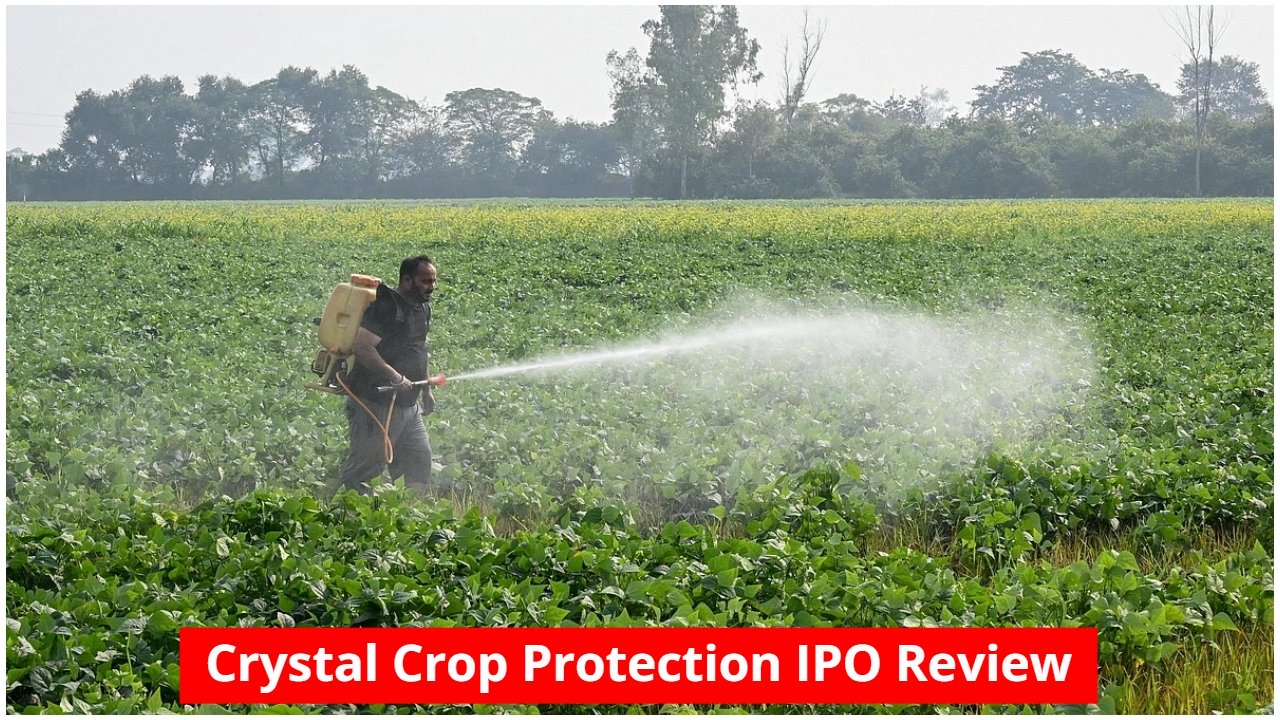
18 November 2026: Crystal Crop Protection IPO review examines the company’s financial growth, ₹455.49 crore public issue, valuation and major risks to help investors understand whether this agricultural business deserves attention.
Crystal Crop Protection IPO Review: Company Business and Growth Potential
Crystal Crop Protection operates in India’s agricultural inputs industry, offering crop protection chemicals and hybrid seeds to farmers. The company has built a presence across different agricultural markets through its established brands, distribution network and product development capabilities. Moreover, its business model combines branded products, research-led innovation and strategic acquisitions to expand its market presence.
Its product portfolio includes well-known brands such as Bavistin, Tilt and Proclaim. Additionally, the company operates through a distribution network of 14,717 distributors across 23 states and four union territories. This extensive network allows Crystal Crop Protection to reach farmers in different regions while reducing its dependence on individual distribution channels.
The company has also completed 13 business and brand acquisitions to strengthen its product portfolio. Consequently, these acquisitions have helped it enter new product segments and expand its market reach without depending entirely on internally developed products.
Also Read: Gold Rate Today: Gold Prices Take a Big Hit! Is It the Right Time to Buy?
Research and development also play an important role in its growth strategy. Crystal Crop Protection holds 18 granted Indian patents, of which 14 have been commercialised. Furthermore, products developed internally generated gross margins of 53% in FY26. This indicates that proprietary products can contribute meaningfully to the company’s profitability.
Meanwhile, branded sales increased by 18.51%, suggesting continued demand for its established product portfolio. However, investors should assess whether the company can maintain this growth while managing rising inventory, borrowing requirements and competitive pressure.
Crystal Crop Protection IPO Financials: Revenue, Profit and Cash Flow Analysis
Financial performance is one of the strongest aspects of this public issue. Crystal Crop Protection has delivered consistent revenue growth over the last two financial years. Moreover, its operating profitability has improved faster than its revenue, indicating better operating efficiency.
Here is a comparison of its reported financial performance:
| Financial Metric | FY24 | FY26 |
|---|---|---|
| Revenue | ₹2,229.93 crore | ₹3,151.97 crore |
| EBITDA | ₹209.06 crore | ₹456.23 crore |
| Net Profit | ₹87.24 crore | ₹144.91 crore |
| Operating Margin | 9.38% | 14.47% |
| ROCE | 10.39% | 16.06% |
Revenue increased from ₹2,229.93 crore in FY24 to ₹3,151.97 crore in FY26, representing an 18.89% CAGR. According to the supplied IPO comparison, this was the highest revenue growth among its five listed peers.
Additionally, EBITDA more than doubled during the same period, rising from ₹209.06 crore to ₹456.23 crore. Operating margins also improved from 9.38% to 14.47%. Therefore, the company appears to be gaining operating efficiency as its business expands.
Also Read: No More QR Code Scanning? UPI Tap & Pay Could Change, Here is Everything Explained
Net profit increased from ₹87.24 crore to ₹144.91 crore. Similarly, return on capital employed improved to 16.06% in FY26 from 10.39% in FY24. These figures indicate progress in the company’s ability to generate returns from its business operations.
However, the cash flow situation deserves closer attention. Operating cash flow declined from ₹383.03 crore in FY25 to ₹256.42 crore in FY26. At the same time, inventory increased from ₹744.76 crore in FY24 to ₹1,379.07 crore in FY26.
This rising inventory level indicates that more money remains tied up in stock. Consequently, the company may need additional working capital to support its operations and future expansion. Investors should therefore look beyond revenue and EBITDA growth and examine whether the business can convert its reported profits into sustainable cash generation.
Crystal Crop Protection IPO Date, Price Band, Issue Size and Other Details
Before evaluating the investment opportunity, investors should understand the basic issue details. The company is launching a ₹455.49 crore IPO with a price band of ₹259 to ₹272 per share.
The following table summarises the key information available in the supplied IPO details.
| IPO Details | Information |
|---|---|
| Company Name | Crystal Crop Protection Limited |
| IPO Opening Date | November 18, 2026 |
| IPO Closing Date | Not officially confirmed in the supplied information |
| Issue Size | ₹455.49 crore |
| Price Band | ₹259–₹272 per share |
| Lot Size | Not officially confirmed in the supplied information |
| Fresh Issue or OFS | Complete breakup not provided |
| IPO GMP | Not officially confirmed |
| Subscription Status | Live subscription figures not provided |
| Allotment Date | Not officially confirmed in the supplied information |
| Listing Date | Not officially confirmed in the supplied information |
Moreover, investors should not rely on unofficial estimates for the lot size, grey market premium or allotment schedule. These details require confirmation through the relevant official IPO documents and exchange announcements.
The issue also includes a proposed allocation of ₹270 crore towards repayment of borrowings at the company and its subsidiary. Therefore, reducing debt represents an important objective of the public issue.
Crystal Crop Protection IPO Objects of the Issue: Where Will the Money Go?
One important consideration when analysing an IPO is understanding how the company plans to use the proceeds. In Crystal Crop Protection’s case, ₹270 crore has been earmarked for repaying borrowings at the company and its subsidiary.
Debt repayment could improve the company’s financial position by reducing outstanding loans. Additionally, lower borrowings may help reduce interest expenses and provide greater financial flexibility for future business operations.
However, investors should not assume that the proposed repayment will eliminate the company’s debt-related concerns. Crystal Crop Protection reported fund-based borrowings of ₹962.67 crore as of August 31, 2026.
Consequently, even after the proposed repayment, the company will continue to carry financial obligations. Its ability to manage these borrowings while funding inventory and business expansion will remain important.
Investors should also examine the complete issue structure to understand the allocation between fresh issue and offer for sale. The detailed breakup has not been provided in the supplied information, so it would be inappropriate to assume how much existing shareholders intend to sell.
Crystal Crop Protection IPO Risks: Debt, Inventory and Legal Concerns
Despite its improving financial performance, Crystal Crop Protection faces several business and financial risks. These concerns deserve attention because they could affect profitability, cash flow and the company’s ability to maintain growth.
1. High dependence on the Indian agricultural market
Crystal Crop Protection generated 95.38% of its FY26 revenue from the domestic market. Therefore, its business remains closely connected to India’s agricultural conditions.
Monsoon patterns, seasonal farming activity and changes in crop cultivation can influence demand for agricultural inputs. Moreover, unfavourable weather conditions could affect farmers’ purchasing capacity and reduce demand for certain products.
2. Dependence on raw materials and Chinese suppliers
Raw materials accounted for 68.95% of the company’s total expenses. Additionally, Chinese suppliers contributed 41.82% of its material costs.
This creates a potential supply-chain risk. For example, disruptions in imports, changes in international chemical prices or regulatory restrictions could increase procurement costs. Consequently, the company may face pressure on its operating margins if it cannot pass higher costs to customers.
3. High borrowings and working capital requirements
The company’s fund-based borrowings stood at ₹962.67 crore as of August 31, 2026. Although ₹270 crore of the IPO proceeds will support debt repayment, the remaining financial obligations still require careful monitoring.
Meanwhile, the increase in inventory from ₹744.76 crore in FY24 to ₹1,379.07 crore in FY26 highlights its working capital requirements. If inventory levels continue to rise faster than sales, the company could face additional pressure on cash flow.
4. Legal proceedings and cheque-bouncing cases
The company also faces certain legal and financial uncertainties. These include proceedings involving alleged export duty refund violations amounting to ₹75.53 crore.
Additionally, the supplied information mentions 305 cheque-bouncing cases involving ₹68.79 crore. These matters create uncertainty around potential financial exposure and payment recovery.
However, investors should distinguish between pending proceedings and established liabilities. The final financial impact will depend on the outcomes of the relevant cases.
Crystal Crop Protection IPO Valuation: Is ₹272 Per Share Expensive?
Valuation is arguably the most important concern in this IPO. At the upper price band of ₹272, the company’s estimated post-issue market capitalisation stands at approximately ₹4,438 crore.
Based on FY26 net profit, this translates into an estimated P/E ratio of 30.63x. In simple terms, investors would pay approximately 30.63 times the company’s reported annual earnings at this valuation.
To understand whether this pricing looks reasonable, it is useful to compare Crystal Crop Protection with other listed agricultural input companies.
| Listed Company | P/E Ratio |
|---|---|
| Crystal Crop Protection | 30.63x |
| Bayer CropScience | 22.73x |
| Rallis India | 19.93x |
| Dhanuka Agritech | 14.38x |
| Sumitomo Chemical India | 31.20x |
The comparison shows that Crystal Crop Protection commands a higher valuation than Bayer CropScience, Rallis India and Dhanuka Agritech. However, its estimated P/E remains slightly below Sumitomo Chemical India’s valuation.
The premium partly reflects Crystal’s strong revenue growth and improving operating margins. Nevertheless, a closer examination of profitability reveals some concerns.
Its FY26 net profit margin stood at 4.56%, while ROE was 7.94%. Both figures were the lowest among the five listed companies in the supplied comparison.
On the other hand, Sumitomo Chemical India reported a PAT margin of 16.04% and ROE of 17.30%. It also had no net debt in the comparison.
Therefore, investors are being asked to pay a relatively high valuation for a company that still has comparatively weaker net profitability and shareholder returns.
This does not automatically make the IPO unattractive. However, Crystal Crop Protection must demonstrate that its revenue growth can translate into stronger earnings, healthier cash flow and improved capital efficiency.
Crystal Crop Protection vs Dhanuka Agritech and Rallis India
A comparison with established agricultural companies can help investors understand the valuation difference.
Dhanuka Agritech operates in the agricultural chemicals and crop protection segment. Rallis India also has a presence in crop protection products and agricultural inputs. Both companies provide useful reference points when assessing Crystal Crop Protection’s business performance and market valuation.
Based on the supplied figures, Crystal Crop Protection has a clear advantage in revenue growth, with an 18.89% CAGR between FY24 and FY26. However, its estimated P/E ratio of 30.63x stands considerably above Dhanuka Agritech at 14.38x and Rallis India at 19.93x.
Moreover, the company’s FY26 net profit margin of 4.56% raises questions about how much of its revenue ultimately reaches shareholders as profit.
Consequently, investors should not compare these companies only on revenue growth. Profitability, return on equity, debt levels, working capital requirements and cash generation also matter.
Crystal’s faster growth provides a positive starting point. Nevertheless, the valuation premium will become more convincing only if the company continues improving its profitability and financial efficiency.
Crystal Crop Protection IPO GMP and Subscription Status: What Investors Should Check
The grey market premium, commonly known as GMP, often attracts attention during an IPO. However, it does not represent an official exchange price or guarantee the listing performance of a company.
For Crystal Crop Protection, the IPO GMP has not been officially confirmed in the supplied information. Therefore, investors should avoid making an application decision based entirely on unverified grey market figures.
Similarly, the live subscription status can provide an indication of investor demand across different categories. However, subscription figures alone do not establish whether an IPO offers attractive long-term value.
Investors should also monitor the official allotment status and listing date announcements after the subscription process concludes. These details should come from recognised exchange or registrar platforms rather than unverified social media updates.
Most importantly, a strong subscription response or positive GMP cannot compensate for an expensive valuation or weak financial fundamentals.
Crystal Crop Protection IPO Subscribe or Avoid: Who Should Consider It?
The decision to subscribe depends on an investor’s risk appetite, investment horizon and expectations from the agricultural sector.
Investors who prefer companies with strong revenue growth may find Crystal Crop Protection interesting. Its established brands, extensive distributor network and research capabilities provide a foundation for business expansion. Additionally, the improvement in EBITDA and operating margins indicates that the company has made progress in strengthening its operations.
However, valuation remains a significant concern. At approximately 30.63x FY26 earnings, the company is not entering the market at a particularly inexpensive valuation.
Furthermore, its working capital requirements, borrowings and relatively low ROE increase the risks for investors who prioritise financial stability and consistent cash generation.
Before applying, investors should consider the following factors:
– Revenue growth and the sustainability of its market expansion.
– Improvement in EBITDA and net profit margins.
– Reduction in inventory and working capital requirements.
– Debt repayment and future borrowing levels.
– Operating cash flow compared with reported earnings.
– Legal proceedings and potential financial exposure.
– Valuation compared with established listed competitors.
Moreover, investors should read the company’s offer documents and understand the risks before making a final decision. Short-term listing expectations and long-term investment suitability are two different considerations.
Crystal Crop Protection IPO Review: Final Verdict
Crystal Crop Protection has demonstrated strong revenue growth, improved operating margins and an established presence in India’s agricultural inputs market. Its brands, distribution network, acquisitions and research capabilities provide a foundation for further expansion. Additionally, the proposed debt repayment could offer some relief to its balance sheet.
However, the valuation demands caution. At approximately 30.63x FY26 earnings, the company commands a premium despite its 4.56% net profit margin, relatively low ROE and substantial working capital requirements.
The biggest question is whether Crystal Crop Protection can convert its impressive revenue growth into stronger net profits and consistent cash generation. Investors should also monitor inventory levels, outstanding borrowings and the impact of ongoing legal proceedings.
Overall, this Crystal Crop Protection IPO review highlights both the company’s growth potential and the financial risks attached to its valuation. Rather than relying only on revenue growth or IPO market sentiment, investors should assess profitability, cash flow and valuation before deciding whether the issue suits their investment strategy.
Frequently Asked Questions
| FAQ | Answer |
|---|---|
| What is the Crystal Crop Protection IPO price band? | The price band is ₹259 to ₹272 per share. |
| When will the Crystal Crop Protection IPO open? | The IPO opens on November 18, 2026. |
| What is the total issue size? | The total IPO issue size is ₹455.49 crore. |
| Is Crystal Crop Protection IPO good to apply? | The company offers strong revenue growth, but its premium valuation, debt and working capital requirements deserve careful consideration. |
| What is the Crystal Crop Protection IPO P/E ratio? | Its estimated post-issue P/E ratio is approximately 30.63x based on FY26 earnings. |
| What are the major risks of Crystal Crop Protection IPO? | Key risks include agricultural market dependence, raw material costs, inventory requirements, borrowings and ongoing legal proceedings. |
| What will the company use the IPO proceeds for? | ₹270 crore has been earmarked for repayment of borrowings at the company and its subsidiary. |