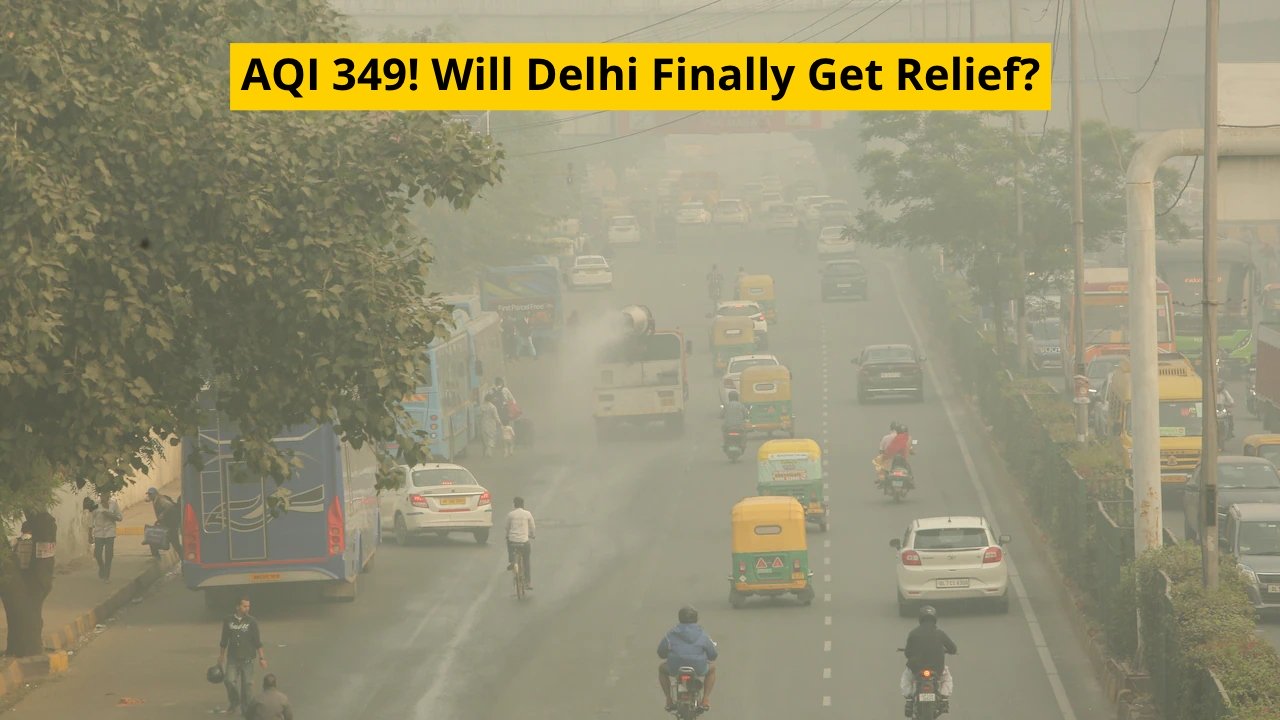
Delhi recorded an AQI of 349 on Saturday, showing a slight improvement in air quality. However, pollution levels remain very poor as the IMD forecasts rain and stronger winds for Sunday, offering hope for some relief.
Delhi AQI Today: Air Quality Remains in the Very Poor Category
Delhi witnessed a modest improvement in air quality on Saturday, with the overall Air Quality Index (AQI) settling at 349. Although the reading marked a slight recovery, residents still faced very poor air quality across the national capital.
Meanwhile, two air quality monitoring stations recorded pollution levels in the severe category. As a result, concerns over worsening air pollution continue, particularly for children, older adults and people with respiratory conditions.
The improvement comes after a particularly difficult Friday, when Delhi’s AQI crossed the 400 mark and remained in the severe category for nearly eight hours. However, Saturday’s reading offered a small sign of relief for residents struggling with persistent pollution.
IMD Rain Forecast Brings Hope for Pollution Relief
Delhi residents could experience some relief as the India Meteorological Department (IMD) has forecast very light rainfall or drizzle in isolated parts of the capital on Sunday.
According to the weather department, a fresh Western Disturbance is likely to affect northwest India, bringing changing weather conditions to Delhi and neighbouring areas.
Moreover, stronger winds and possible rainfall could help disperse pollutants accumulated in the atmosphere. Consequently, these weather changes may improve air quality and bring some relief from the prevailing pollution.
However, the actual improvement will depend on rainfall intensity, wind speed and the movement of pollutants across the region. Therefore, residents should not expect an immediate or guaranteed improvement in air quality.
Delhi Weather Update: Temperatures Remain Above Normal
Along with air pollution, Delhi has also experienced relatively warm weather over the past few days. According to data from the Safdarjung weather station, the maximum temperature reached 31.4 degrees Celsius on Saturday.
This reading stood 2.9 degrees Celsius above the seasonal average. Meanwhile, the minimum temperature settled at 16.2 degrees Celsius, which was also 2.7 degrees above normal.
Furthermore, the absence of rainfall in recent days has contributed to dry weather conditions. Combined with unfavourable atmospheric conditions, the lack of rain has allowed pollutants to remain concentrated near the surface.
As a result, residents have experienced both elevated temperatures and poor air quality, making outdoor activities less comfortable.
Wind Direction and Speed Could Affect Delhi’s Air Quality
Wind conditions play an important role in determining pollution levels in Delhi. On Saturday, south-westerly winds prevailed at speeds of around 10–15 kmph.
Meanwhile, the weather department reported moderate fog at isolated locations during the morning hours.
The wind direction was also expected to change towards the north-west around midday, with speeds remaining between 10 and 15 kmph.
However, this change could bring another concern. North-westerly winds may carry smoke from agricultural fires in Punjab and Haryana towards the national capital, potentially increasing pollution levels.
Therefore, although stronger winds generally help disperse pollutants, their direction also matters. Depending on the source and movement of pollution, changing wind patterns can either improve or worsen Delhi’s air quality.
Delhi Temperature Forecast: Cooler Nights Expected
The IMD has also predicted a noticeable drop in night-time temperatures between November 16 and November 19.
According to the forecast, minimum temperatures could fall by around 3–5 degrees Celsius during this period. Consequently, Delhi residents may experience cooler mornings and nights.
Meanwhile, maximum temperatures are expected to remain between 25 and 28 degrees Celsius. Minimum temperatures could range from 13 to 16 degrees Celsius.
The expected change in temperature will bring a shift towards cooler weather. However, lower temperatures alone will not guarantee cleaner air, as pollution levels also depend on wind movement, atmospheric stability and emissions.
How Delhi Residents Can Protect Themselves from Air Pollution
Despite the slight improvement in AQI, Delhi’s air quality remains a concern. Therefore, residents should continue taking precautions until pollution levels fall to healthier ranges.
Additionally, people can follow a few simple measures to reduce their exposure:
1. Avoid outdoor exercise: Limit running, jogging and strenuous outdoor activities when pollution levels remain very poor or severe.
2. Wear a suitable mask: Use a well-fitting N95 mask when going outdoors, particularly in heavily polluted areas.
3. Keep windows closed during high pollution: Reduce outdoor air entering your home when pollution levels rise, while maintaining appropriate indoor ventilation and filtration.
4. Monitor AQI updates: Check official air quality updates before planning outdoor activities.
5. Take extra care of vulnerable groups: Children, older adults and people with asthma or other respiratory conditions should take additional precautions.
Delhi Air Pollution and Weather Forecast: What to Expect Next
Delhi’s AQI of 349 on Saturday indicates a slight improvement compared with Friday’s severe pollution levels. Nevertheless, the overall situation remains concerning.
The IMD’s rainfall forecast and expected stronger winds could provide temporary relief by helping disperse pollutants. Moreover, cooler nights are likely to bring some relief from the recent above-normal temperatures.
However, the possibility of smoke from farm fires in neighbouring states and unfavourable atmospheric conditions could continue to affect air quality.
For now, Delhi residents should keep track of weather forecasts and official AQI readings while following necessary health precautions.
| FAQ | Answer |
|---|---|
| What was Delhi’s AQI on Saturday? | Delhi recorded an overall AQI of 349, placing it in the very poor category. |
| Will it rain in Delhi on Sunday? | The IMD forecast very light rain or drizzle at isolated places in Delhi and nearby areas. |
| Can rainfall improve Delhi’s air quality? | Yes. Rainfall and stronger winds can help disperse pollutants, although the improvement depends on weather conditions. |
| What was Delhi’s maximum temperature on Saturday? | The Safdarjung weather station recorded a maximum temperature of 31.4 degrees Celsius. |
| When will Delhi experience cooler nights? | Night-time temperatures are forecast to fall by 3–5 degrees Celsius between November 16 and November 19. |